Tongs are the difference between a confident heat and a fumbled one. Buy the wrong jaw shape and you will fight every hammer blow; buy the right one and the steel sits still while you work. For beginners, the choice often comes down to four profiles: flat, bolt, wolf-jaw and pick-up. Here is what each one does, where it struggles, and how to decide what to put on your tong rack first.
Why jaw shape matters more than brand
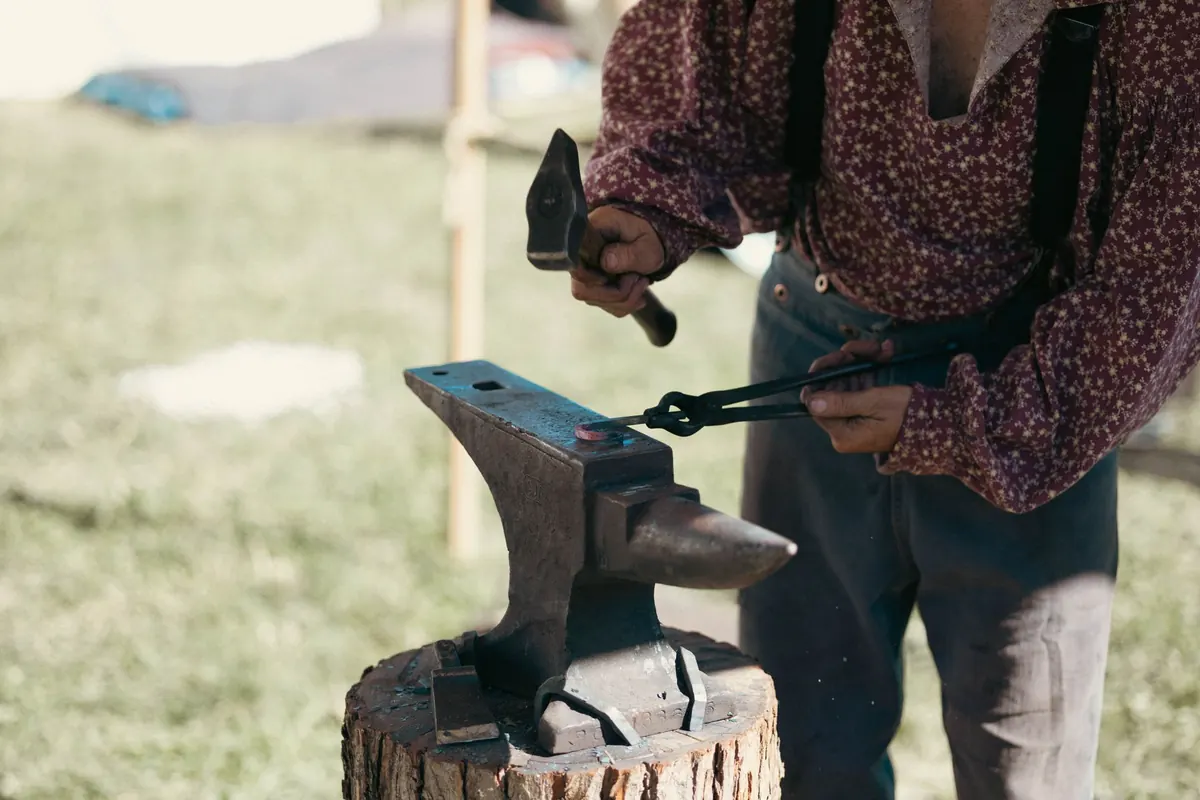
A tong is a lever with a hinge. The rivet is the fulcrum, the reins are the effort, and the jaws are where the load sits. If the jaws do not match the stock, you compensate with grip pressure. That tires your hand, encourages slipping, and sends more vibration up your arm. Good tongs do not need a death grip. They hold because the jaw profile cradles the workpiece.
Before you look at brands or finishes, ask: what stock will I hold most? Flat bar, square bar, round bar, hex, or a mix? The answer decides the jaw.
Flat jaws: the generalists
Flat-jaw tongs are the everyday workhorses. The jaws are flat where they meet, often with a slight curve or blunt tip. They are happiest on flat bar and square bar, especially when the jaw width matches the stock. A pair that fits 25 mm x 6 mm flat will hold that stock securely. Put a round bar in them and you are asking for trouble: the contact is a line, not a face, so the stock rolls.
Look for jaws that close parallel. Hold them up to a light: a sliver of light along the full length is fine, but if the tips touch and the heels gape, they will pinch rather than hold. For beginners, a pair of flat tongs sized to your most-used flat stock is a sensible first purchase.
Bolt tongs: for round and hex
Bolt tongs have a V-shaped or rounded groove in each jaw. That groove gives round and hex stock three or more points of contact, which stops it spinning. They are the right choice for holding bolts, round bar, and hex stock. Some bolt tongs have a single V; others have a V plus a smaller groove for two sizes. If you work mostly with round bar, bolt tongs are not a luxury—they are the correct tool.
They are less useful on flat bar. A flat section can sit in the V, but it will not be as stable as it would be in flat jaws. If you only have one pair, a bolt tong with a wide V can handle square stock reasonably well, but it is a compromise.
Wolf-jaw tongs: the compromise
Wolf-jaw tongs—sometimes called universal tongs—try to do everything. The jaws usually have a V-notch in the centre and flat surfaces on either side. That lets them grip round, square, and flat stock without changing tongs. For a beginner on a budget, one well-made pair of wolf-jaw tongs can cover a lot of ground.
The catch is that they are masters of none. The flat surfaces may not be as wide as true flat jaws, and the V may not match your round stock as precisely as a dedicated bolt tong. They are a good second pair or a practical first pair if you genuinely work with mixed stock. Check that the V is deep enough to cradle the round bar you use most, and that the flat areas are wide enough for your flat stock.
Pick-up tongs: for moving, not hammering
Pick-up tongs are designed for moving hot metal, not for holding it under the hammer. They typically have long reins and simple jaws—often flat or slightly curved—that can grab a range of shapes. The long reins keep your hand away from the forge and the heat. That makes them excellent for pulling a billet from the fire, moving a workpiece to the anvil, or quenching.
What they are not is a substitute for fitting tongs. If you hammer while using pick-up tongs, the stock can shift, and you will tire quickly. Use them for what they are good at: transport. Many smiths keep a pair by the forge for exactly that reason.
Fit, grip and first purchases
Checking the fit
Fit is everything. Here is a quick check you can do before you buy or when you make your own:
- Insert the stock you plan to hold. Close the reins with one hand. The jaws should contact the stock along their length, not just at the tips.
- Shake gently. If the stock rattles or rotates, the jaws are too large or the wrong profile.
- Hold the tongs as you would at the anvil. You should be able to keep the stock steady with a firm but not exhausting grip. If your forearm burns after a minute, the fit is wrong.
- Check the reins. They should be long enough that your knuckles clear the anvil and the hot zone. For general work, overall length around 400–500 mm is a useful starting point, but comfort matters more than a number.
Grip
Hold the reins near the ends for leverage, but not right on the tips. Your thumb can rest along the side of the rein for control. Do not white-knuckle. If the tongs fit, you should be able to relax between blows.
First purchases
- A pair of flat tongs sized to your most-used flat or square stock.
- A pair of bolt tongs sized to your most-used round or hex stock.
- Optional: a pair of wolf-jaw tongs if you work with mixed stock and want one pair to do more.
- A pair of pick-up tongs for moving hot metal, if you do not already have a safe way to do that.
If you can only afford one pair, match it to the stock you use most. Do not buy a pair of tongs for a size you do not own. Tongs are not universal; they are a match to the metal.
A simple rule to finish
Buy tongs that fit the steel in front of you, not the steel you dream of forging. Start with flat and bolt jaws in your common sizes, add a wolf-jaw pair if you need versatility, and keep pick-up tongs for the forge. Check the fit every time you change stock. When the jaws cradle the work, your hammer does the talking.
Photo: Owen.outdoors / Pexels